
A three-layer architecture spanning payments, circulation and participation rights takes aim at the commercial infrastructure gap left behind as model capabilities converge
Dallas, Texas--(Newsfile Corp. - July 27, 2026) - ARKIE AI today introduced the AI Value System, a three-layer framework for AI commerce built on a contrarian premise: that the next phase of competition in artificial intelligence will be decided not by model performance, but by the economic architecture built around it.
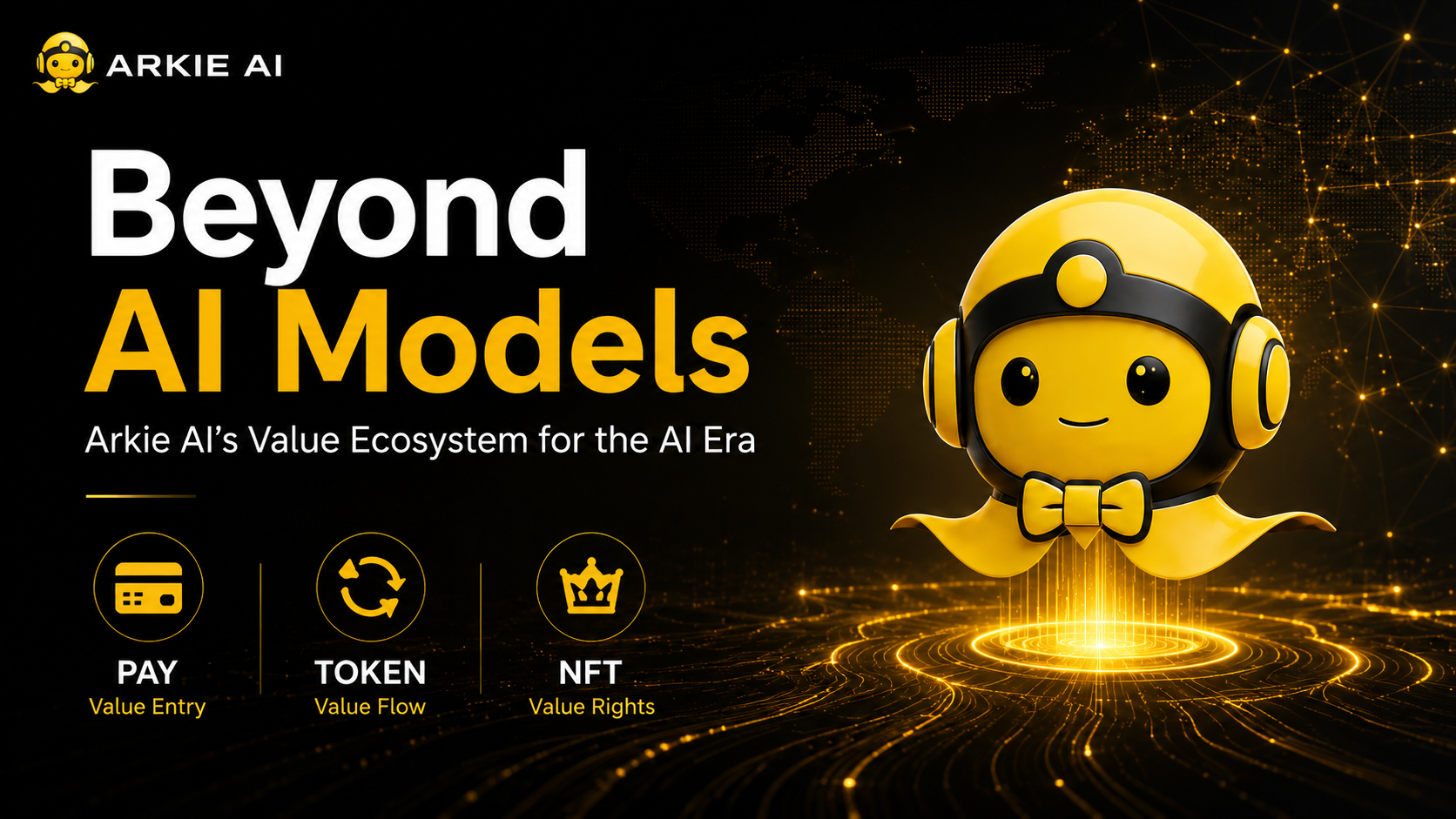
To view an enhanced version of this graphic, please visit:
https://images.newsfilecorp.com/files/8111/306340_arkie1en.jpg
The framework spans three layers — Value Entry, Value Flow and Value Rights — and reflects a view gaining traction across the industry. As frontier models converge in capability, differentiation is shifting away from benchmarks and toward the systems that determine how value created by AI is captured, moved and shared.
Capability has outrun commercial design
Model development has outpaced business model development for several years. Writing, coding, translation, design and video generation are now table stakes across OpenAI, Google, Anthropic and a fast-improving open-source field. What has not kept pace is the commercial plumbing underneath.
Most AI products still run on a business model inherited from the consumer internet: users pay a subscription, vendors book the revenue, platforms reinvest in R&D. Value moves in one direction and stops.
That model becomes harder to defend as AI agents take on transactional work. An agent that buys services, procures inventory, calls paid APIs and manages assets is not a chat interface — it is a commercial actor. Supporting it, ARKIE AI argues, requires more than a better model. It requires infrastructure for how value is created, circulated and allocated.
Three layers
Value Entry. Existing payment rails were designed for people and merchants. Agent-driven transactions introduce different requirements: machine identity, autonomous authorization, programmatic settlement and on-chain assets. ARKIE AI's answer at this layer is Arkie Pay, a unified entry point that allows AI systems to execute payment, settlement and exchange directly.
Value Flow. Payment is only the first step. In the internet economy, a completed transaction ends the value cycle; in an AI economy, ARKIE AI contends, value needs to keep moving. The company's approach centers on the ARK token as a common medium across payments, consumption, service calls and ecosystem applications. Compared with conventional loyalty points, digital assets are globally transferable, programmable, composable and traceable — properties that make them better suited to carrying value inside an AI ecosystem.
Value Rights. The third layer addresses the question the industry has been slowest to answer: who owns the value AI creates. Models are trained on user contribution, improved by data and commercialized across an entire ecosystem. ARKIE AI's Arkie NFT is positioned at this layer — not as a collectible, but as a record of long-term participation in the ecosystem, intended to make value allocation transparent and verifiable rather than concentrated by default at the platform layer.
Closing the loop
The design goal, according to the company, is a closed cycle rather than a series of one-off transactions: AI creates value, the payment layer captures it, digital assets move it, the rights layer distributes it, and participants reinvest their contribution back into the system.
The framing aligns with the broader "AI Economy" thesis that has gained currency over the past two years — the argument that the decisive variable is not parameter count or reasoning benchmarks, but whether an ecosystem can keep value circulating among the people who help produce it.
A familiar inflection point
Industry history offers a precedent. Search was transformed less by crawling technology than by the distribution economics Google built around it. Mobile was reshaped less by hardware than by the App Store's commercial architecture. Mobile payments changed consumer behavior through networks and settlement infrastructure, not interfaces.
AI appears to be approaching a comparable moment. Model capability is converging quickly; the commercial layer remains early. ARKIE AI's position is that whoever establishes a complete value system first stands to become foundational infrastructure for the next phase of the market — and that the defining question for an AI platform is no longer how capable its model is, but whether the value it generates has somewhere to go.
About ARKIE AI
ARKIE AI is a genie that summons the world's AI for you. It removes the need to study models, compare parameters or learn prompt engineering — users simply describe what they need in plain language, and leading AI systems coordinate automatically to complete the task. ARKIE AI's mission is to put the most advanced artificial intelligence within easy reach of everyone.
At the compute infrastructure layer, ARKIE AI works in partnership with Tencent Cloud to support the platform's ability to serve users at global scale.
Media Contact
Company: Arkie AI
Email: support@arkieai.xyz
Website: https://www.arkieai.io
To view the source version of this press release, please visit https://www.newsfilecorp.com/release/306340